


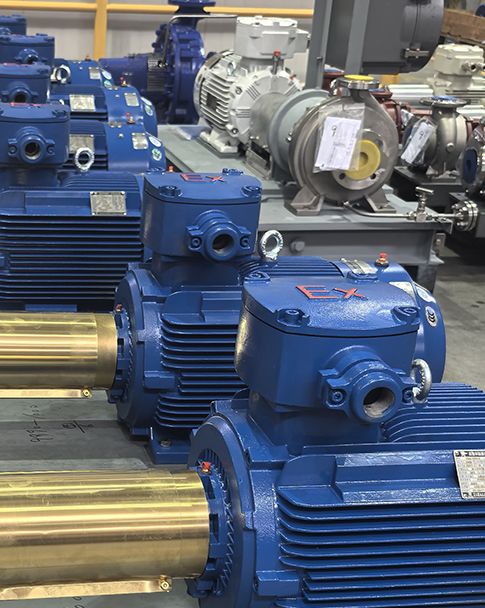
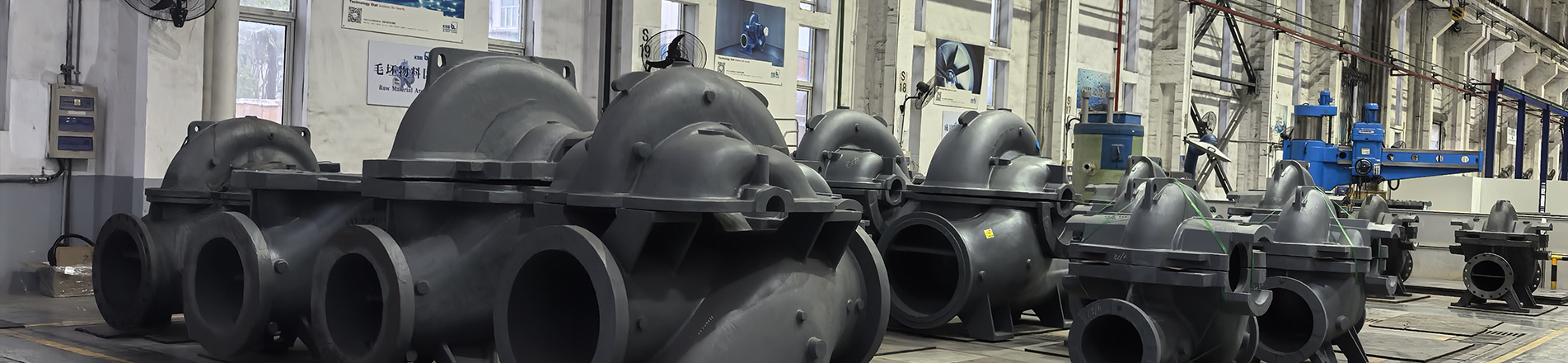
To properly utilize water pumps, selecting the right model is crucial. Proper pump selection ensures adequate water supply volume and pressure while conserving energy. Conversely, inappropriate choices not only reduce equipment utilization efficiency but also lead to energy waste. Overly large pumps or excessively high head heights are common causes of energy inefficiency. Even high-efficiency pumps operating at low head heights will function inefficiently, resulting in increased energy consumption. Therefore, pump selection should prioritize understanding water supply requirements, including head height, flow range, and fluctuation patterns. When choosing pumps, focus should not solely on achieving peak efficiency during maximum flow periods but rather consider regular water supply volumes. Opt for pumps with wide high-efficiency ranges and compatible motors featuring high efficiency and low energy losses. Urban water demand exhibits constant variability—differing by year and season, with daily peak hourly flows reaching 1.3-1.5 times average levels. In smaller towns where water usage is concentrated, peak flow rates may surge to 2.0-2.5 times normal levels. Operating pumps based solely on maximum flow rates rather than actual demand patterns inevitably results in energy waste.
Selection of Pump Performance
For pumps with stable process flow rates, the key performance consideration is ensuring operational efficiency. When the average head fluctuates significantly and requires frequent flow rate adjustments, particular attention must be paid to the flatness of the Q-H and Q-y curves, confirming whether the pump operates within its high-efficiency range.
Energy conservation through rational matching and combined operation of water pumps
1、Rational matching of water pumps
Typical pumping stations are equipped with at least 2-3 working pumps. To optimize energy efficiency and economic operation, it is advisable to pair pumps with similar head but varying flow rates for a balanced configuration. When water demand fluctuates significantly and frequently, adding a variable-speed pump can better accommodate changes in water usage. During peak water consumption periods, the high-capacity pump operates while switching to a low-capacity pump during off-peak hours. This configuration not only reduces the number of pumps in operation but also ensures all units run within their high-efficiency range, resulting in substantial energy savings and enhanced water supply flexibility.
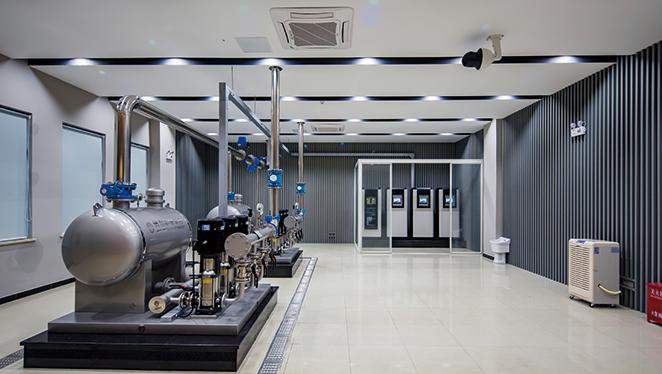
2、Parallel Combined Operation of Water Pumps
In applications requiring high flow rates or significant flow fluctuations, different pump configurations may be employed based on specific conditions to enhance operational efficiency (the maximum number of parallel pumps shall not exceed four).
In urban water supply systems, with the exception of small towns or large factories that utilize water towers for regulation, most cities directly pump water into distribution networks using centrifugal pumps. Flow control is achieved by adjusting the number of pumps in parallel operation—increasing or decreasing their count as needed. During peak daytime water demand periods, additional pumps are activated in parallel mode. This configuration enhances pump head capacity, effectively meeting both urban water consumption requirements and hydraulic pressure standards.
For instance, a water treatment plant experiences maximum pump head of approximately 50 meters during peak water usage periods, while dropping to around 25 meters during nighttime off-peak hours. The significant disparity in head performance between daytime and evening operations has led to the long-term parallel operation of pumps with identical head specifications. Although this configuration meets peak demand requirements, it becomes inadequate during low-water periods, resulting in reduced pump efficiency and high energy consumption. Therefore, pump selection should be tailored to the specific water supply system's operational conditions to ensure efficient operation within optimal performance ranges. To further enhance energy efficiency and accommodate variable flow demands, existing equipment modifications—including pump replacement systems designed for nighttime operation during low water consumption periods—can significantly improve pump efficiency and reduce power consumption per unit. Such upgrades can yield substantial annual electricity savings.
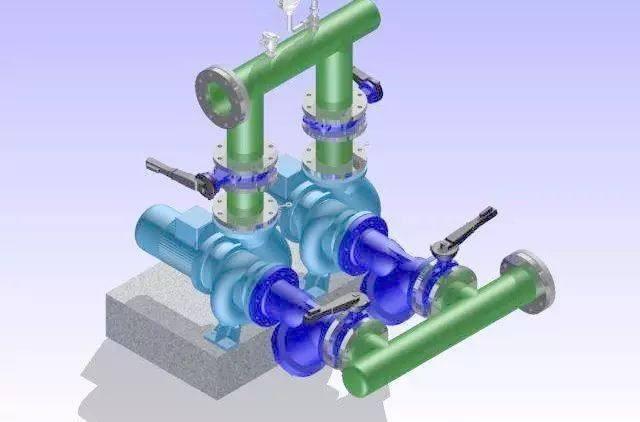
Energy-saving through Pump Speed Control Technology
1. Principle of Energy Saving through Pump Speed Regulation
The energy-saving principle of pump speed regulation can be derived from the similarity law of fluid mechanics. The relationship between performance and rotational speed is as follows: flow rate is directly proportional to rotational speed, head is proportional to the square of rotational speed, and power is proportional to the cube of rotational speed.
2. Conditions for pump speed regulation and selection of speed-regulated pumps
① Conditions for selecting pump speed regulation
When water supply volume exhibits significant seasonal/daily variations or demonstrates high time variation coefficients, pumps frequently operate at high head or off-design conditions characterized by large flow rates and low head within the high-efficiency range. In cases where pump model selection is not feasible, variable-speed pumps should be considered as an alternative solution.
② Selection of speed-regulating pump
When multiple pumps are available, the one with the highest flow rate and most frequent operation should be selected as the speed-regulating pump. The operating point of the speed-regulating pump must be positioned at the midpoint of the pump's high-efficiency range—specifically, at the right end of this range when operating at rated speed, or even slightly beyond it. Additionally, pumps with excessively low or high specific speed (ns) are unsuitable for this role. Centrifugal pumps with medium-to-high specific speeds (ns=80-300) demonstrate optimal performance as speed-regulating pumps.
3、Methods and Characteristics of Pump Speed Regulation
① Thyristor cascade speed control features high efficiency and mature technology, suitable for speed regulation within 70–95% range. However, the speed control device exhibits low power factor and causes grid pollution.
② Electromagnetic slip speed control features simple control, stable and reliable operation, ease of remote and automatic control, and high power factor, but has the disadvantage of slip loss.
③ Liquid viscosity governor (also known as oil film clutch) features large adjustment capacity, compact size, and speed regulation capability within the rated speed range of 30%–100%. It offers low manufacturing costs. However, oil film clutches require high-quality mechanical oil and exhibit certain slip loss.
④ Frequency conversion speed regulation is the most advanced method among speed control technologies, offering significant energy-saving potential, low noise levels, stable pressure in water supply networks, convenient maintenance and management, and minimal malfunctions, albeit at a high cost.
4. Determination of Optimal Speed Ratio for Water Pump
Pump theory indicates that within a limited speed range, variations in pump rotational speed alter the characteristic curve, thereby shifting the operating point to the high-efficiency zone.
Strengthen energy balance testing of water pumps, and promptly update or retrofit them to improve operational efficiency and achieve energy-saving objectives.
1. Regularly measure pump characteristics, primarily Q-H and Q-y curves. If the pump efficiency is found to be significantly low, promptly replace the pump or impeller.
2. For single-stage pumps with improper selection or excessive head and flow rate, reducing the head and flow rate by turning the impeller outer diameter can be employed to operate within the high-efficiency range. The turning amount of the impeller is related to specific speed; excessive turning may lead to insufficient pump efficiency, resulting in counterproductive outcomes. A stepwise turning method is generally adopted to achieve optimal impeller turning parameters.
Strengthen the maintenance and management of water pumps, actively adopt new technologies and materials, and improve pump efficiency.
1. Improve the processing and assembly quality of pumps to ensure safe and reliable operation, and minimize the clearance of the mouth ring as much as possible;
2. Enhance maintenance by promptly repairing appropriate leakage gaps. When leakage gaps exceed specified values due to detected rupture or wear of the port ring, repairs or replacements should be performed. Based on empirical data and actual measurements, the port ring radius gap should be determined to be 2.5–3.5% of the impeller port ring outer diameter.
3. Actively adopt novel sealing fillers. Fillers serve as water or gas barriers in shaft sealing devices. Selecting a filler with superior sealing performance can not only resolve leakage issues and reduce consumption but also enhance pump efficiency to a certain extent.




 IPv6 network supported.